
Why Do My Hands Go Numb at Night?
Share with a friend

Learn why hands go numb at night, including carpal tunnel and nerve compression, plus safe sleep position tips, treatment options, and when to seek timely medical advice.
You wake up with tingling fingers, a numb palm, or the feeling that your hand has fallen asleep. You change position, move your fingers, and wait for the sensation to return. If it happens again the next night, it is natural to wonder what is causing it.
Hands can go numb at night when a sleeping position puts pressure on a nerve. Carpal tunnel syndrome at the wrist and ulnar nerve compression at the elbow are common explanations. A nerve problem in the neck or another health condition can also cause hand numbness. The pattern matters, especially which fingers are affected and whether symptoms continue during the day. www.nhs.uk
Call 911 for sudden, unexplained numbness or weakness on one side of the body, especially with facial drooping, trouble speaking, vision changes, or loss of balance. These can be signs of a stroke. Get emergency help even if the symptoms disappear. www.canada.ca
Why numbness can be worse while you sleep
Sleeping on your arm, curling your wrists under a pillow, or keeping your elbows tightly bent can place pressure on nerves for an extended period. Temporary pins and needles from lying on an arm usually settle after you take the pressure off.
With an existing nerve compression problem, the same sleeping position may trigger symptoms repeatedly. Numbness that keeps waking you up deserves assessment, even if your hand feels normal again by breakfast. www.nhs.uk
Common causes of numb hands at night
Carpal tunnel syndrome
Carpal tunnel syndrome occurs when the median nerve is compressed as it passes through a narrow space in the wrist. It typically affects the thumb, index finger, middle finger, and thumb-side half of the ring finger. The little finger is usually spared.
Symptoms often appear at night, particularly when the wrist stays bent. As the condition progresses, you may notice daytime tingling, difficulty with small objects, or reduced grip strength. www.orthoinfo.org
Ulnar nerve compression at the elbow
If your little finger and the adjacent side of your ring finger go numb, the ulnar nerve may be involved. Compression at the elbow is called cubital tunnel syndrome.
This nerve passes close to the surface at the inside of the elbow, near the “funny bone.” Sleeping with the elbow deeply bent or leaning on it can aggravate symptoms. The tingling may be felt mainly in the hand even though the irritation is at the elbow. www.orthoinfo.org
A nerve irritated in the neck
A nerve root in the neck can become irritated or compressed, sometimes because of disc or arthritic changes. This is called cervical radiculopathy. It can cause hand tingling or numbness, with pain that travels from the neck into the shoulder or arm. Arm or hand weakness may also occur. An examination helps distinguish a neck problem from compression at the wrist or elbow. www.orthoinfo.org
Other conditions affecting nerve health
Diabetes, vitamin B12 deficiency, an underactive thyroid, and some medicines can contribute to peripheral neuropathy, which means damage to nerves outside the brain and spinal cord. Tell your healthcare provider if you also have tingling in your feet or symptoms that are not clearly related to position. Do not assume you need supplements or stop a medication without advice. www.nhs.uk
What the finger pattern may tell you
These patterns can help you describe your symptoms. They are clues for an assessment, not a way to diagnose yourself.
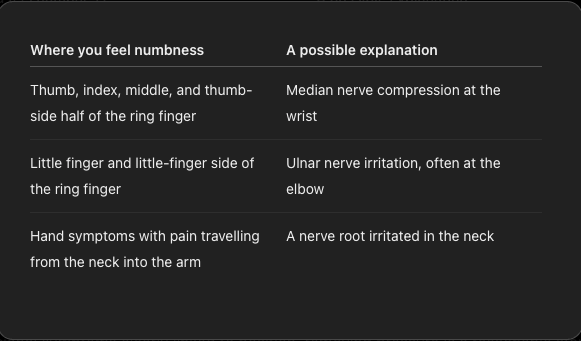
The location of symptoms helps guide an examination, but similar symptoms can have different causes. www.orthoinfo.org
Steps that may help at night
For occasional symptoms clearly linked to position, removing pressure is a reasonable starting point. If numbness keeps returning, arrange an assessment while making these adjustments.
- Avoid lying on your hands or arms. Move your hand out from under your body or pillow and choose a position that leaves the arm uncompressed. www.nhs.uk
- Keep your wrist comfortably straight. If carpal tunnel syndrome is suspected or diagnosed, ask a healthcare professional about a properly fitted night splint that holds the wrist near neutral. A tight wrap is not a substitute. www.nhs.uk
- Reduce prolonged elbow bending. If the ring and little fingers are affected, avoid sleeping with the elbow tightly folded and avoid resting your weight on it. A clinician can advise whether an elbow support would help. www.orthoinfo.org
- Modify activities that trigger symptoms. Take breaks from sustained gripping or repeated wrist bending, and change how you hold tools or other objects when those positions bring on tingling. www.nhs.uk
- Keep a brief symptom record. Note the fingers affected, whether one or both hands are involved, how long numbness lasts, and any change in strength. Bring this information to your appointment.
Avoid repeatedly testing the hand with forceful stretches or deep pressure. If an exercise or massage increases tingling, stop and have it reassessed. Protect numb skin from burns and other injuries because reduced sensation can make them harder to notice. www.medlineplus.gov
When to have numbness assessed
Book an appointment with your family doctor or nurse practitioner if numbness keeps coming back, interrupts sleep, persists after you change position, or starts occurring during the day. Worsening grip, repeatedly dropping objects, difficulty with buttons, or visible loss of hand muscle also need prompt attention. www.nhs.uk
Seek emergency care for sudden weakness or inability to move the hand or arm, or numbness following a head, neck, or back injury. Do not wait for a massage appointment to assess these symptoms. www.medlineplus.gov
Your clinician will ask about your symptoms and examine the relevant areas. Depending on the findings, blood tests or nerve conduction studies may be appropriate. Not everyone needs testing, and treatment should follow the cause identified. www.nhs.uk
Can massage therapy help?
Massage may have a supporting role when hand symptoms occur alongside muscle discomfort, but its suitability depends on the cause of the numbness. An RMT should know about any altered sensation, weakness, diagnosis, or treatment plan before starting care.
For mild to moderate carpal tunnel syndrome, current physical therapy guidance allows selected hands-on techniques for short-term improvements in pain and function. However, an American Academy of Orthopaedic Surgeons guideline found limited evidence suggesting that massage and manual therapy do not produce lasting improvements in carpal tunnel symptoms and function. Short-term relief should not be taken as proof that nerve compression has resolved. doi.org
Massage should therefore complement appropriate assessment and treatment. It cannot be relied on to reverse nerve damage or replace a recommended splint, medical treatment, or surgical consultation. If treatment causes more numbness or an electric, shooting sensation, tell your therapist immediately so they can stop and reassess.
Questions patients often ask
Can both hands be affected?
Yes. Carpal tunnel symptoms can occur in both hands, and sleeping positions may affect either side. Bilateral symptoms do not establish the cause. Persistent symptoms, especially with tingling elsewhere, should be discussed with your healthcare provider. www.niams.nih.gov
Can pregnancy cause numb fingers at night?
Yes. Pregnancy-related swelling can increase pressure in the carpal tunnel. Symptoms may improve after pregnancy, but you should still mention them to your maternity care provider. A suitable wrist splint may help, and symptoms that persist after birth need follow-up. www.nhs.uk
Does relief from shaking the hand mean it is harmless?
No. Moving or shaking the hand can temporarily relieve carpal tunnel symptoms. If you repeatedly need to do this during the night, seek assessment rather than assuming the problem has gone away. www.niams.nih.gov
Massage therapy at Aurelia RMT in Toronto
If you are considering massage for accompanying neck, shoulder, or forearm discomfort, let us know about your hand symptoms before your appointment. Share any medical assessment or treatment recommendations so the suitability of massage can be considered.
You can contact Aurelia RMT or book an appointment online to discuss your massage therapy goals. Recurrent or worsening numbness should also be assessed by your medical provider.
Book an appointment with Aurelia RMT
This article provides general education and does not replace an individual medical assessment.
Key Takeaways
- ✓Nighttime hand numbness often results from pressure on nerves during sleep. Common causes include carpal tunnel syndrome at the wrist and ulnar nerve compression at the elbow.
- ✓The affected fingers offer clues: thumb, index, and middle finger symptoms may suggest carpal tunnel syndrome, while ring and little finger symptoms may involve the ulnar nerve. These patterns do not confirm a diagnosis.
- ✓Avoid sleeping on your arms, keep wrists comfortably straight, and reduce prolonged elbow bending. Ask a healthcare professional whether a properly fitted night splint could help.
- ✓Arrange a medical assessment if numbness recurs, disrupts sleep, persists during the day, or comes with weakness or dropping objects. Call 911 for sudden one-sided numbness or weakness, especially with facial drooping, speech difficulties, or balance changes.
- ✓Massage may help accompanying muscle discomfort, but it does not replace assessment or treatment for nerve compression. Stop treatment if it increases numbness or causes shooting sensations.
Frequently Asked Questions
Why do my hands go numb while I sleep?
Sleeping on your arm or keeping your wrists or elbows bent can put pressure on nerves. Common causes include carpal tunnel syndrome at the wrist and ulnar nerve compression at the elbow. Neck problems and other health conditions can also cause numbness. Repeated symptoms should be assessed by a healthcare provider.
Can the fingers affected help explain what is causing the numbness?
Numbness in the thumb, index, middle, and thumb-side half of the ring finger can suggest carpal tunnel syndrome. Numbness in the little finger and adjacent half of the ring finger can suggest ulnar nerve compression. These patterns are clues, not a diagnosis.
What can I do to reduce hand numbness at night?
Avoid sleeping on your hands or arms, keep your wrists comfortably straight, and avoid tightly bending your elbows. If carpal tunnel syndrome is suspected, ask a healthcare professional about a properly fitted night splint. Arrange an assessment if numbness keeps returning.
Can massage therapy help with numb hands?
Massage may help accompanying muscle discomfort and offer short-term relief in some cases, but it does not reliably resolve nerve compression or reverse nerve damage. Tell your therapist about numbness, weakness, and any medical recommendations before treatment. If massage increases tingling or causes an electric, shooting sensation, tell your therapist immediately so they can stop and reassess.
When should I seek medical help for hand numbness?
Book an assessment if numbness repeatedly interrupts sleep, persists after changing position, occurs during the day, or comes with worsening grip or dropping objects. Seek emergency care for sudden weakness, inability to move the hand or arm, or numbness after a head, neck, or back injury. Call 911 for sudden, unexplained one-sided numbness or weakness, especially with facial drooping, speech difficulties, vision changes, or loss of balance—even if symptoms disappear.
Explore Our Complete Toronto RMT Guide
Looking for more information about massage therapy in Toronto? Our comprehensive guide covers everything from common conditions to treatment options.
View the Complete Guide