
Stretching vs. Strengthening: What Do You Need Between Massages?
Share with a friend

Learn when stretching or strengthening between massages can improve flexibility, build strength, and support easy movement with personalized advice from an RMT therapist.
You leave your massage feeling more comfortable, then wonder what to do before your next appointment. Should you stretch the areas that felt tight? Start strengthening them? Give them a break?
The answer depends on what is limiting your movement and affecting your daily life. Stretching can help improve flexibility. Strengthening develops your ability to manage physical demands. Your home-care plan may include both, with the balance guided by your symptoms, activities, and assessment.
What stretching and strengthening do
Stretching involves moving into a position that gently lengthens a muscle and holding it, or moving through a range repeatedly. Its main purpose is to maintain or improve flexibility.
Strengthening makes your muscles work against resistance, which can come from your body weight, a resistance band, or weights. With an appropriate challenge and gradual progression, it can improve strength and muscular endurance. These abilities support everyday tasks such as climbing stairs, lifting groceries, and getting out of a chair. NHS
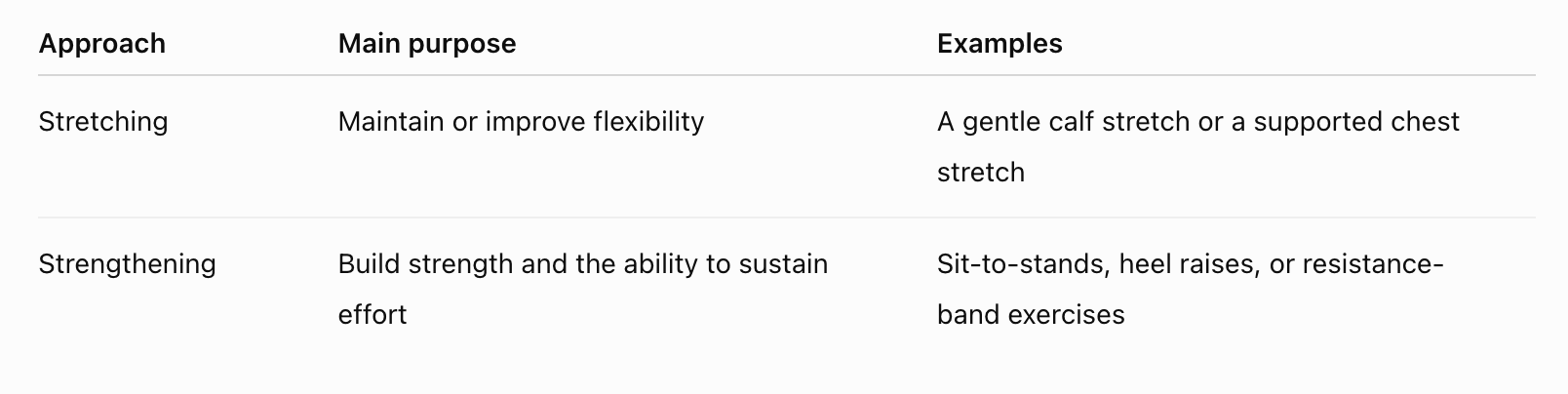
The benefits can overlap. A review of 55 studies in healthy participants found that resistance training with external loads could also improve joint range of motion. That finding does not tell us which exercise will treat an individual patient’s pain, but it shows that building strength and improving flexibility can happen together. PMC
Feeling tight does not automatically mean you need to stretch
The word “tight” describes a sensation. On its own, it does not tell you which exercise will help.
Someone with very flexible joints can still experience stiffness and discomfort. Joint hypermobility is one example: patients may have a large range of movement alongside muscle or joint pain. Management commonly includes improving strength and fitness, while avoiding repeatedly pushing joints beyond their normal range. NHS
If a stretch provides brief relief but the same discomfort keeps returning, tell your therapist. That pattern is useful information, but it does not prove that the muscle is too short or too weak. It is a reason to review the plan.
When stretching may be useful
Stretching may be appropriate when an assessment identifies limited flexibility that affects a movement you want or need to do. For example, a gentle calf stretch might be included in a plan addressing limited ankle movement.
For general stretching, warm up with a few minutes of easy movement first. Move slowly until you feel a mild pulling sensation, keep breathing, and avoid bouncing. A hold of around 30 seconds is a common starting point, although your therapist may suggest something different for your situation. A stretch should not feel sharp or painful. Mayo Clinic
Pay attention to what happens afterward. Does the movement feel easier? Can you do the relevant activity more comfortably? Those observations are more useful than seeing how far you can push into the stretch.
If you already have plenty of movement, ask whether gaining more range would help with your particular goal.
When strengthening deserves more attention
Strengthening is worth discussing when everyday tasks feel physically demanding, when you are returning to activity after a period of doing less, or when your assessment identifies reduced strength or endurance.
For example, difficulty repeatedly getting up from a chair may lead to a gradual sit-to-stand programme. A person returning to longer walks might work on leg strength alongside walking. These are examples of matching exercise to a task, not diagnoses based on a symptom.
You do not need to begin with heavy weights. A stable chair, a wall, or a light resistance band can provide a manageable starting point. The challenge can increase as the exercises become easier and your body tolerates them. NHS
For general adult health, the World Health Organization recommends muscle-strengthening activity involving the major muscle groups on at least two days each week. That is a broad health target; an exercise plan for an injury or painful condition may begin differently. who.int
How massage fits into the plan
Massage may provide short-term relief for some types of pain, including certain neck and shoulder complaints. The strength of the evidence and the duration of benefit vary by condition. NCCIH
If treatment helps you feel more comfortable moving, discuss how to build on that with appropriate activity. Massage and exercise have different roles: hands-on care may help with symptoms, while exercise gives you a way to practise movement and gradually develop physical capacity.
Returning discomfort does not automatically mean the massage failed or that you did something wrong. Tell your RMT what improved, how long the change lasted, and which activities brought symptoms back. That information can help guide reassessment, changes to home care, or a referral when needed.
Keep your between-appointment routine manageable
Ask your therapist to help you choose a small number of exercises with a clear purpose. One mobility exercise and one strengthening exercise may be a practical starting discussion, but neither is compulsory for every patient.
Before leaving your appointment, make sure you know:
- The purpose: What movement or everyday task is this exercise meant to help?
- The amount: How many repetitions or holds should you do, and how often?
- The response: What should it feel like, and what means you should stop or modify it?
- The progression: When should you increase the challenge, and when should you check back in?
For instance, an individually selected plan might combine a gentle calf stretch with supported heel raises. Another patient may need comfortable shoulder movements and a light resistance exercise. The useful combination depends on the assessment, not simply the location of the discomfort.
On massage day, ask whether your usual routine needs adjusting. If the treated area feels tender, choose comfortable activity and follow any specific advice about reducing the intensity or postponing a particular exercise.
Use your response to guide adjustments
Watch how you feel during exercise, later that day, and the following morning. If your usual symptoms become noticeably worse or an exercise creates new pain, stop that exercise and discuss an adjustment. The number of repetitions, resistance, movement range, or recovery time may need to change. NHS guidance for common musculoskeletal problems similarly advises gradual progression and reassessment when exercises worsen symptoms. NHS inform
Avoid pushing through sharp pain or an electric, shooting sensation. Seek medical advice for new numbness or weakness, and prompt assessment if these symptoms are worsening.
If you have a recent injury, have had surgery, or have a condition that affects exercise safety, get individual guidance before starting a new routine.
Bring your home-care questions to your next massage
At your next Aurelia RMT appointment, describe what you would like to do more comfortably: turn your head while driving, carry groceries, return to the gym, or get through your workday with less discomfort.
Ask whether stretching, strengthening, or a combination makes sense for that goal. Bring up anything that feels confusing or difficult to fit into your day, so the advice can be made more practical.
Visit aureliarmt.com to book an appointment and discuss your symptoms and goals with Aurelia.
Explore Our Complete Toronto RMT Guide
Looking for more information about massage therapy in Toronto? Our comprehensive guide covers everything from common conditions to treatment options.
View the Complete Guide