
Plantar Fasciitis Flare-Up: What to Do in the First 48 Hours
Share with a friend

Learn exactly what to do in the first 48 hours of a plantar fasciitis flare-up—from pain-calming home care and supportive footwear to gentle movement strategies—and when to seek professional help.
If you’re dealing with a plantar fasciitis flare-up, the first 48 hours can feel tender, frustrating, and honestly a little scary, especially when that first step in the morning hits like a sharp reminder.
Let’s slow it down together. The goal in the first two days is not to “fix” everything. It’s to calm the flare, reduce irritation, and protect the area so it can start settling. If you’re in Toronto and this keeps repeating, you do not have to manage it alone.
1) First, make sure it’s safe to treat at home
Most plantar fasciitis flare-ups are not emergencies, but heel pain can sometimes be something else.
Please get medical help sooner (urgent or same-day) if:
- You cannot put weight on your foot
- The pain started right after an injury or fall
- There’s significant swelling, heat, redness, fever, or an open wound
- You have numbness or tingling that’s new or worsening
- You have diabetes or poor circulation and new heel pain
If none of those fit, home care for 48 hours is usually reasonable.
2) The first 48 hours: your three priorities
Think of this as calm, support, and gentle movement.
Calm the irritation (day 1 and day 2)
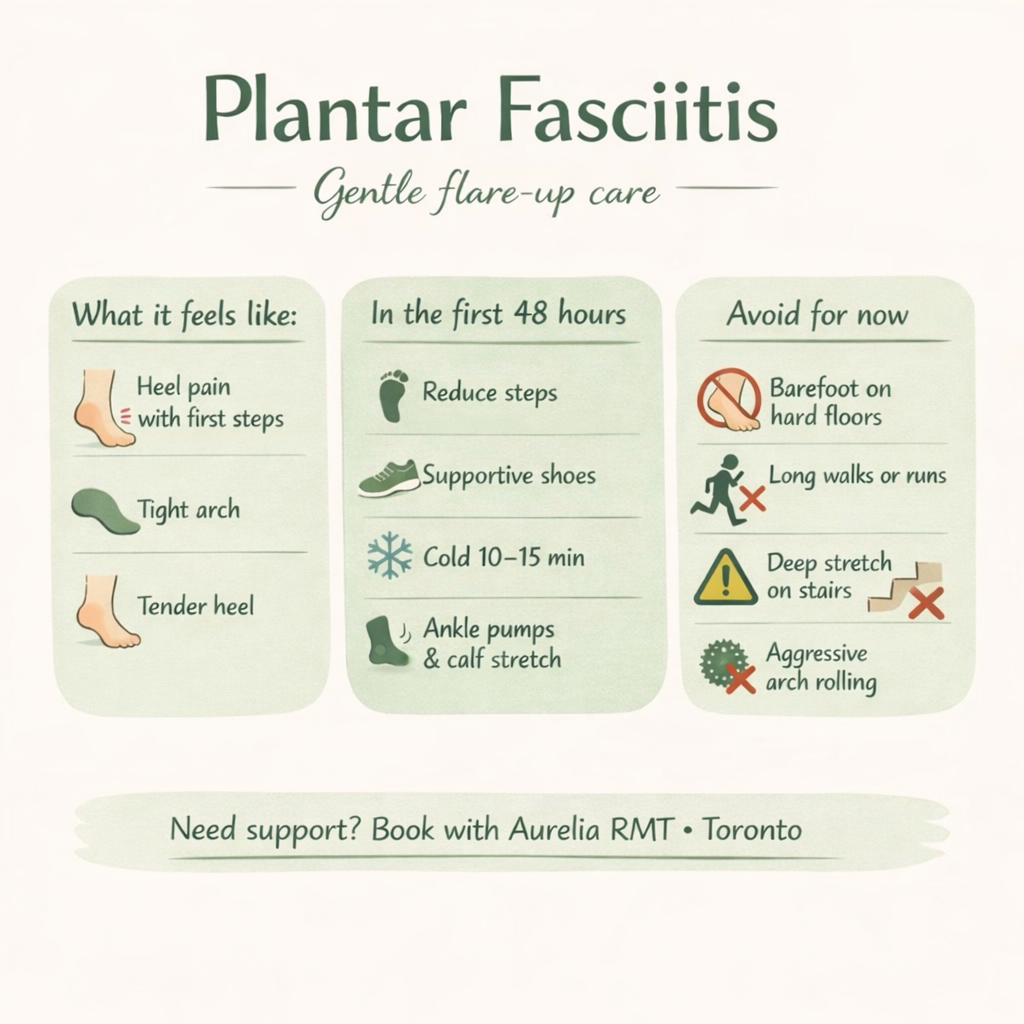
- Reduce your steps for 1–2 days. Not total rest, just fewer unnecessary trips.
- If cold feels soothing, try 10–15 minutes of ice (wrapped) a few times a day, especially after being on your feet.
- Avoid testing it with “just one more walk” to see if it’s better. Flares hate being challenged.
Support the foot (right away)
- Do not go barefoot on hard floors right now, even at home.
- Wear supportive shoes or slippers with some structure.
- If you have them, use arch support inserts.
- If you know how to tape your arch comfortably (or have done it before), light support can help for short periods.
Keep a little gentle movement (so it doesn’t stiffen up)
You’re aiming for “easy and warm,” not intense stretching or deep pressure.
3) A simple 48-hour routine you can actually follow
Morning (the “first-step” moment)
Before you stand:
- Ankle pumps: point and flex your foot slowly, 20–30 times.
- Gentle circles: 10 each direction.
- Then step into supportive footwear before walking around.
This often softens that first sharp pull.
Midday
- Keep shoes on indoors if possible.
- Take short “movement snacks” instead of one long outing.
- If you need to be on your feet, take micro-breaks and sit when you can.
Evening
- If it feels good, do light calf stretching (nothing aggressive):
- Knee straight, heel down, gentle lean into a wall
- 20–30 seconds, 2–3 times each side
- If rolling the arch feels relieving, use a ball very lightly for 30–60 seconds.
- If it feels sharp or angry after, skip it for now.
4) What to avoid for now (even if you’re tempted)
For the first 48 hours, I’d avoid:
- Long walks, running, hills, and stairs as “exercise”
- Barefoot stretching on the edge of a step
- Deep, aggressive arch massage that leaves the area sore
- Thin, unsupportive shoes (or worn-out sneakers)
If something makes the pain “flare and linger” afterward, it’s too much for today.
5) When massage therapy can help (and what I’d focus on)
A flare-up is often not just about the sore spot in your heel. Common contributors include calf tightness, foot overload, and tender tissues that are working too hard.
In a session, I’ll usually focus on:
- Calming surrounding tension (calves, ankle, foot muscles)
- Gentle, supportive hands-on work (not forcing pain)
- Practical guidance for walking, footwear, and pacing
- Helping you build a plan so this doesn’t keep cycling back
If your heel pain keeps returning, or you’re modifying your life around it, that’s a good sign it’s time for support.
Ready for a calmer next step?
If you’re in Toronto and your plantar fasciitis flare-up is making everyday walking feel stressful, you can book a session with me at Aurelia RMT. We’ll keep it grounded, practical, and built around your real life, not a perfect routine.
Key Takeaways
- ✓Most plantar fasciitis flare-ups aren’t emergencies, but sudden severe pain, inability to bear weight, signs of infection, or new numbness/tingling (especially with diabetes or poor circulation) need prompt medical attention.
- ✓In the first 48 hours, the priorities are to calm irritation (fewer steps, optional short ice sessions), support the foot (no barefoot on hard floors, use supportive shoes/arch supports/taping), and keep gentle movement so the area doesn’t stiffen.
- ✓Use a simple routine: before getting up do ankle pumps and circles, wear supportive footwear all day, break activity into short bouts with micro-breaks, and in the evening only use light calf stretching and very gentle arch rolling if it feels relieving.
- ✓Avoid long walks, running, hills, stairs as exercise, aggressive stretching (like hanging off a step), deep painful arch massage, and thin or worn-out shoes—anything that makes pain flare and linger is too much for now.
- ✓Massage therapy can help by easing tension in the calves and foot, using gentle hands-on work, and giving practical guidance on walking, footwear, and pacing; if heel pain keeps returning or limiting your life, it’s a good time to seek this support, including at Aurelia RMT in Toronto.
Frequently Asked Questions
How do I know if my heel pain from a plantar fasciitis flare-up is safe to treat at home or if I should see a doctor right away?
It’s usually reasonable to manage a plantar fasciitis flare-up at home for the first 48 hours if you don’t have any red flags. Get urgent or same-day medical help if: you cannot put weight on your foot at all, the pain started right after an injury or fall, there is significant swelling, heat, redness, fever, or an open wound, you have new or worsening numbness or tingling, or you have diabetes or poor circulation and new heel pain. If none of these apply, you can typically try home care focused on calming irritation, supporting the foot, and keeping some gentle movement.
What should I actually do in the first 48 hours of a plantar fasciitis flare-up?
Think in terms of calm, support, and gentle movement. Calm: reduce your steps for 1–2 days (not total rest) and, if it feels soothing, use ice wrapped in a cloth for 10–15 minutes a few times a day, especially after being on your feet. Support: avoid going barefoot on hard floors, wear supportive shoes or slippers with structure, use arch support inserts if you have them, and consider light taping if you already know how to do it comfortably. Gentle movement: do easy, non-aggressive movements so the foot doesn’t stiffen—like ankle pumps and circles before standing, short “movement snacks” through the day, and light calf stretching in the evening if it feels good.
What can I do about that sharp pain with my first step in the morning?
Before you stand up, spend a minute or two moving the ankle. Do 20–30 slow ankle pumps (pointing and flexing your foot) and about 10 gentle circles in each direction. Then step directly into supportive footwear instead of walking barefoot to the bathroom or kitchen. This simple routine often softens that first sharp pull when you put weight on your foot.
Are there things I should avoid during a plantar fasciitis flare-up, even if they seem like they might help?
Yes. For the first 48 hours, avoid long walks, running, hills, and stairs as “exercise,” barefoot stretching on the edge of a step, deep or aggressive arch massage that leaves the area sore, and thin or very worn-out shoes. As a rule, if something makes the pain flare and then linger afterward, it’s too much for right now and should be scaled back or skipped.
How can massage therapy help if my plantar fasciitis flare-ups keep coming back, and what would you focus on in a session?
Massage therapy can help by calming the tissues that are working too hard around the heel, not just the sore spot itself. In a session, I’d typically focus on reducing tension in the calves, ankle, and foot muscles, using gentle, supportive hands-on work rather than forcing pain. I’d also give practical guidance on walking, footwear, and pacing your activity, and help you build a realistic plan so the flare-ups don’t keep cycling back. If you’re in Toronto and you’re changing your daily life around heel pain, that’s a good time to book a session at Aurelia RMT for more structured support.
References & Citations
- [1] Heel Pain–Plantar Fasciitis: Revision 2023 (Clinical Practice Guideline), JOSPT.- The Orthopaedic Section of the American Physical Therapy Association (APTA) has an ongoing effort to create evidence-based practice guidelines for orthopaedic physical therapy management of patients with musculoskeletal impairments described in the World Health Organization's International Classification of Functioning, Disability, and Health (ICF). The purpose of these revised clinical practice guidelines is to review recent peer-reviewed literature and make recommendations related to nonarthritic heel pain.
- [2] Morrissey et al., 2021 (Best practice guide for plantar heel pain), BJSM. - Objective To develop a best practice guide for managing people with plantar heel pain (PHP). Methods Mixed-methods design including systematic review, expert interviews and patient survey. Data sources Medline, Embase, CINAHL, SPORTDiscus, Cochrane Central Register of Controlled Trials, trial registries, reference lists and citation tracking. Semi-structured interviews with world experts and a patient survey. Eligibility criteria Randomised controlled trials (RCTs) evaluating any intervention for people with PHP in any language were included subject to strict quality criteria. Trials with a sample size greater than n=38 were considered for proof of efficacy. International experts were interviewed using a semi-structured approach and people with PHP were surveyed online.
- [3] Rhim et al., 2021 (Systematic review of systematic reviews, plantar fasciitis interventions), PMC.- The number of systematic review and meta-analyses on plantar fasciitis is expanding. The purpose of this review was to provide a comprehensive summary of reviews on the topic pertaining to plantar fasciitis, identify any conflicting and inconsistent results, and propose future research direction. A qualitative review of all systematic reviews and meta-analyses related to plantar fasciitis up to February 2021 was performed using PubMed, Embase, Web of Science, and the Cochrane Database. A total of 1052 articles were initially identified and 96 met the inclusion criteria.
- [4] Heel pain: When to see a doctor, Mayo Clinic.- Even mild heel pain can be bothersome, but you usually can safely try simple home remedies for a short time.
- [5] Heel pain (home care and when to see a GP), NHS.- There are lots of causes of heel pain. You can usually ease the pain yourself. But sometimes it can be something more serious like a broken bone.