
Ankylosing Spondylitis and Lower Back Pain: How Is It Different From Regular Back Pain?
Share with a friend

Learn how ankylosing spondylitis lower back pain differs from regular back pain, key inflammatory symptoms, when to seek care, and how massage may help safely.
Lower back pain that keeps returning deserves attention, particularly when it feels worse after resting and improves once you start moving. This pattern can occur with inflammatory back pain, including pain associated with ankylosing spondylitis. It does not mean that every stiff morning or sore back is a sign of arthritis. [1]
The useful difference is how the pain behaves over time. Knowing what to notice can help you describe your symptoms to a healthcare provider and understand where massage fits into your care.
What is ankylosing spondylitis?
Ankylosing spondylitis, often shortened to AS, is a form of inflammatory arthritis that affects the spine and commonly the sacroiliac joints, where the base of the spine meets the pelvis. It can cause lower back or buttock pain, stiffness and reduced mobility. In some people, new bone forms and parts of the spine fuse, but fusion does not happen to everyone. [1, 4]
AS is also called radiographic axial spondyloarthritis. This means characteristic changes in the sacroiliac joints are visible on X-rays. A related condition, non-radiographic axial spondyloarthritis, can cause similar symptoms without those X-ray changes. A normal X-ray therefore does not exclude the broader condition. [6]
What people mean by regular back pain
“Regular back pain” is not a diagnosis. People often use it to describe common mechanical or nonspecific lower back pain. Mechanical pain may involve muscles, joints, discs or other structures and can change with lifting, bending or particular positions. Nonspecific means that a single cause cannot be confidently identified. [2]
A strain after an unfamiliar workout is one example. Other episodes have no obvious trigger. Many improve within a few weeks, although some persist or recur. How intense the pain feels does not, by itself, tell you what is causing it. [2, 11]
How the pain patterns can differ
The following patterns can guide a conversation with your clinician. They cannot confirm or exclude AS on their own.
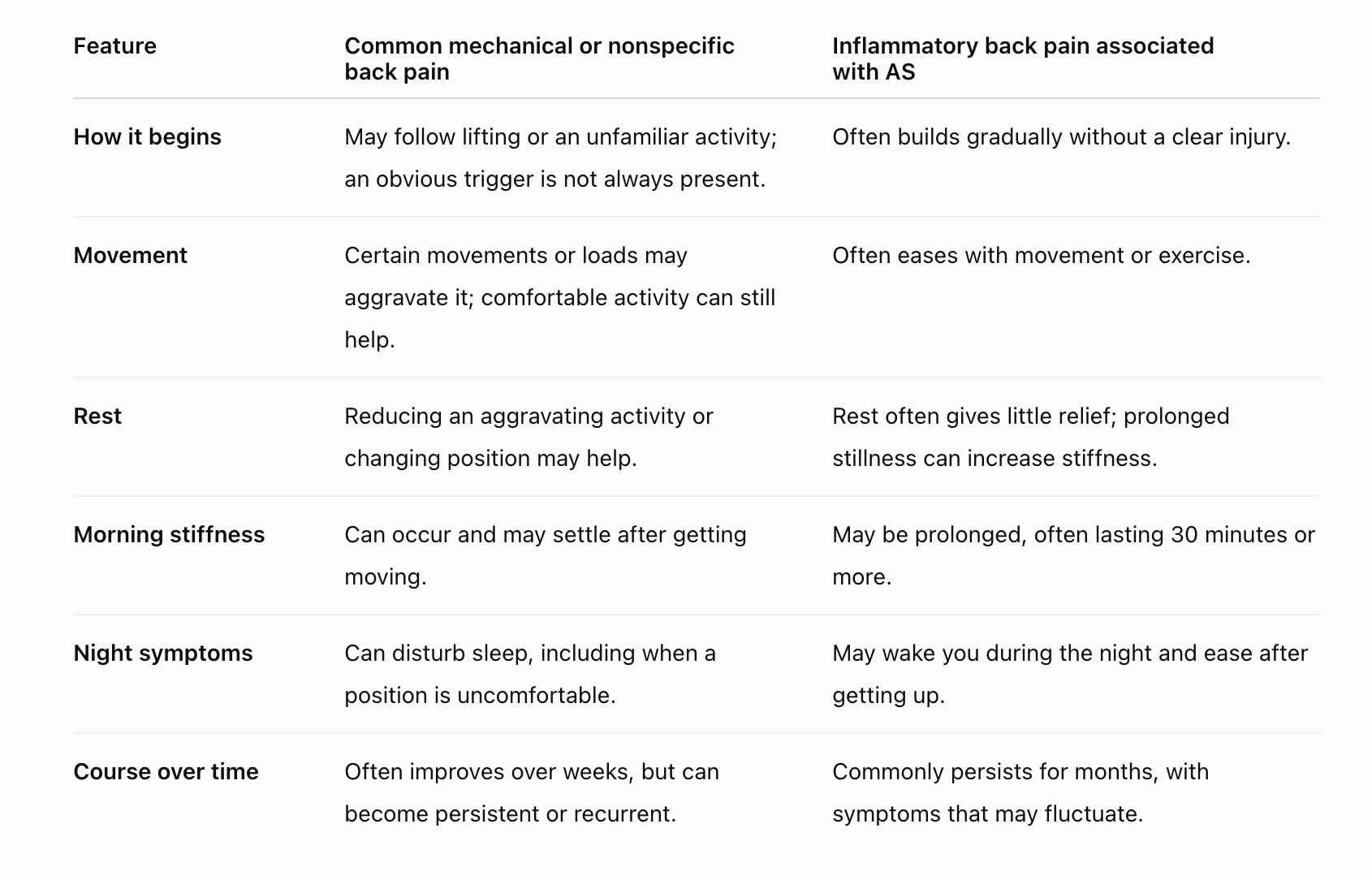
Other clues worth mentioning
Symptoms of axial spondyloarthritis usually begin before age 45, even if diagnosis happens later. It affects women as well as men. Age and sex alone should not be used to dismiss persistent symptoms. [1, 4]
Tell your healthcare provider about back pain alongside any of the following: [1, 5, 7]
- Persistent fatigue or painful, swollen joints elsewhere in the body.
- Recurring heel pain, particularly where the Achilles tendon attaches or beneath the heel.
- A history of psoriasis, inflammatory bowel disease such as Crohn’s disease or ulcerative colitis, or eye inflammation called uveitis.
- A close relative with axial spondyloarthritis or a related inflammatory condition.
These features do not automatically point to AS, but they can help your clinician decide whether further assessment is needed.
When to arrange a medical assessment
Book an appointment with your family doctor or nurse practitioner if lower back pain keeps returning, is not improving after a few weeks, or interferes with sleep and daily activities. Pain lasting more than three months, especially when it began before age 45 and improves with movement, deserves a discussion about possible inflammatory back pain. You do not need to wait three months to seek help. [3, 11]
Bring a short record of when the pain started, how long morning stiffness lasts, whether it wakes you, and what happens after rest or movement. Mention other symptoms and family history. Your primary care provider can assess the pattern and consider referral to a rheumatologist, a doctor who specializes in arthritis and related conditions. [8]
How ankylosing spondylitis is investigated
Diagnosis brings together your symptom history, a physical examination, blood tests and, when appropriate, imaging. A clinician may assess spinal movement and other joints, request tests for inflammation, and consider X-rays or MRI of the sacroiliac joints. [6, 8]
Normal inflammation markers do not rule out axial spondyloarthritis. Neither does a negative HLA-B27 test. A positive HLA-B27 result is also not a diagnosis: many people with this genetic marker never develop the condition. MRI may help when X-rays do not explain the symptoms, but imaging also needs to be interpreted in context. [6, 7]
Massage cannot diagnose AS. It may ease muscle discomfort even when another condition is present, so temporary relief should not be used to decide whether medical assessment is necessary. [7, 9]
Where massage may fit into your care
Management of AS commonly includes medication to address pain and inflammation, along with exercise and physiotherapy. The plan depends on your symptoms and medical assessment. Massage may be considered as an additional approach to comfort, alongside that care. [8, 9]
Some people find massage helpful for muscle tension and relaxation. Others find pressure uncomfortable or notice increased symptoms afterwards. Evidence specifically supporting massage for AS is limited, and it has not been established as a way to control the disease or prevent spinal fusion. [9, 10]
For someone with AS, practical precautions may include using lighter pressure, supporting a comfortable position with pillows, and avoiding forceful stretching or pressure over painful areas. Your RMT should base these adjustments on your symptoms and advice from your healthcare team. Tell your RMT about flares, osteoporosis, spinal fusion, previous fractures and any treatment restrictions. [9, 10]
Forceful spinal manipulation is particularly unsafe when AS has caused spinal fusion or osteoporosis. Treatment should respect your available movement rather than attempt to force a stiff spine into a different position. Stop or modify a session if it increases pain; significant new or worsening symptoms need medical assessment. [10]
Symptoms that need urgent care
Seek emergency care for back pain with new difficulty passing urine, loss of bladder or bowel control, numbness around the genitals or anus, or new or worsening weakness in the legs. These can indicate a serious nerve problem. [11]
Arrange urgent medical assessment for severe pain that starts suddenly, rapidly worsening pain, or back pain with fever or feeling unwell. If you have AS and develop new severe spinal pain after a fall or injury, get urgent assessment because weakened or fused spinal bones can fracture. [11, 12]
A painful red eye, light sensitivity or blurred vision needs urgent, same-day eye assessment. These can be signs of uveitis, an inflammatory eye condition associated with AS. Do not wait for a routine massage appointment to address them. [12]
Considering massage for lower back discomfort
If you have an AS diagnosis and are considering massage in Toronto, contact AureliaRMT to discuss your symptoms, comfort preferences and existing care plan. We can discuss whether massage is appropriate and how treatment may need to be adapted.
For more information, visit aureliarmt.com. If your back pain has not been assessed and the inflammatory pattern sounds familiar, arrange a medical appointment as well.
This article provides general education and does not replace an individual medical assessment.
Sources
- NIAMS. Ankylosing Spondylitis.
- NIAMS. Back Pain.
- Spondylitis Association of America. Overview of Spondyloarthritis.
- Arthritis Society Canada. Axial Spondyloarthritis.
- NHS. Ankylosing Spondylitis Symptoms.
- NHS. Ankylosing Spondylitis Diagnosis.
- NICE. Spondyloarthritis in Over 16s: Diagnosis and Management.
- NIAMS. Ankylosing Spondylitis: Diagnosis, Treatment, and Steps to Take.
- Spondylitis Association of America. Integrative Medicine.
- Spondylitis Association of America. Non-Medicinal Approaches to Treating Spondyloarthritis.
- NHS. Back Pain.
- Mayo Clinic. Ankylosing Spondylitis: Symptoms and Causes.
Explore Our Complete Toronto RMT Guide
Looking for more information about massage therapy in Toronto? Our comprehensive guide covers everything from common conditions to treatment options.
View the Complete Guide