
Piriformis Syndrome Misdiagnosed as Sciatica? Toronto RMT Support for Clarity and Relief
Share with a friend

Leg pain labeled “sciatica” can sometimes be piriformis-related. This guide helps you notice patterns, feel less confused, and know when Toronto RMT support may bring clarity and relief for your body.
If you’ve been told you have sciatica, but the story doesn’t quite fit, you’re not alone. In clinic, I often meet people who feel stuck in that confusing middle place: leg pain, tight hips, a deep ache in the glute, and no clear answer that fully explains it.
Sometimes, what gets labeled as “sciatica” is actually coming from the piriformis area. In other words: piriformis syndrome misdiagnosed as sciatica is a real possibility, and it can leave you feeling uncertain about what your body needs next.
Let’s slow it down together and bring a little more clarity, with gentle, practical support that fits real life in Toronto.
First, a gentle reframe: sciatica is a pattern, not a diagnosis
“Sciatica” usually describes a set of symptoms: pain that can travel from the low back or buttock down the leg, sometimes with tingling, burning, or numbness.
The tricky part is that many different things can irritate the sciatic nerve or nearby tissues, and they can feel similar at first. That’s why people can go through weeks or months of treating the wrong “source,” even while doing all the right things. Epain
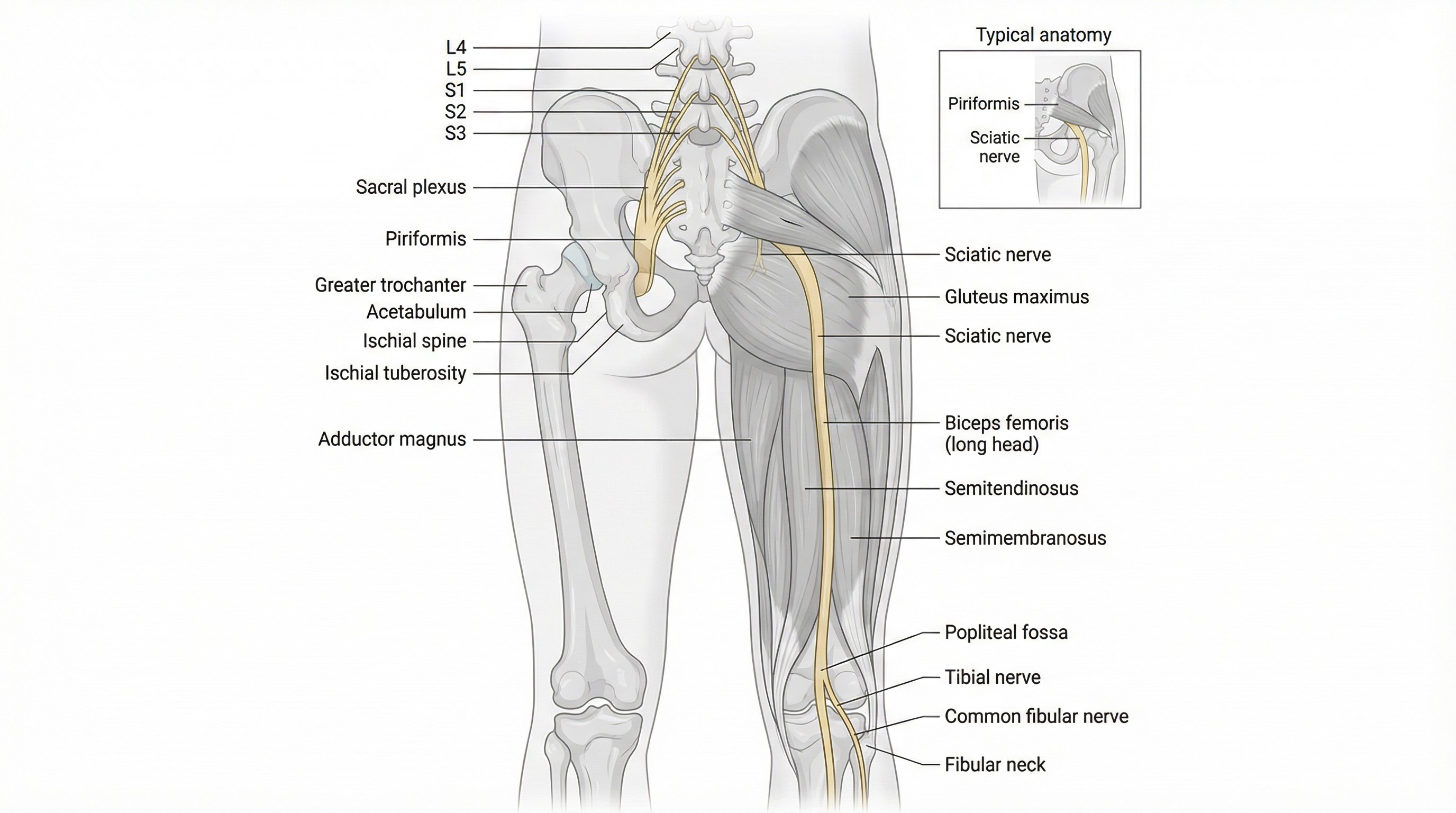
Anatomical pathway of the sciatic nerve from the lower spine (L4–S3) through the pelvis and gluteal region into the back of the thigh, where it divides into the tibial and common fibular nerves.
Where piriformis syndrome fits in
The piriformis is a small, deep muscle in your glute area. In some people, the sciatic nerve runs very close to it (and anatomy can vary). When the area gets irritated, guarded, or overloaded, symptoms can mimic classic sciatica. PMC
Piriformis-related symptoms often feel like:
- A deep ache in the buttock that’s hard to “stretch out”
- Pain that flares after sitting, driving, or long stillness
- Tenderness in one specific glute spot that feels sharp or electric when pressed
- A leg symptom that comes and goes depending on position or load
It’s also worth saying gently: piriformis syndrome can be hard to confirm, and it’s often discussed as a diagnosis of exclusion. That uncertainty is frustrating, but it doesn’t mean your pain isn’t real. PubMed
A few clues that can help you sort the story
This is not a diagnosis (that’s not an RMT’s role), but these patterns can help guide next steps.
Piriformis involvement is more likely when you notice:
- Pain starts in the glute first, then refers down the leg
- Sitting is the biggest trigger (especially driving)
- You feel a very specific “hot spot” in the deep glute
- Movement sometimes helps more than rest (once you get going)
Lumbar nerve root irritation (a more classic “spine-driven” sciatica pattern) is more likely when you notice:
- Clear low-back pain with leg symptoms
- Symptoms strongly worsen with coughing/sneezing/straining
- Numbness or weakness feels progressive or consistent
- Pain follows a very defined line into the foot
Many people have a blend of factors. Bodies rarely read textbooks.
How massage therapy can support clarity and relief
In a session, my goal is to help you feel heard, assessed, and less unsure about what your body is signaling.
A Toronto RMT session can support you with:
- A calm intake that maps your symptoms: where it starts, what aggravates it, what eases it, and what it’s been like day to day
- Hands-on assessment of the glutes, hip rotators, and surrounding tissues, looking for protective tension and sensitivity patterns
- Gentle, specific soft tissue work to the piriformis region (and often the bigger “helpers” like glute med/min, deep rotators, and hip flexors)
- Nervous system downshifting: when pain has been loud for a while, your system can stay braced. Sometimes the biggest shift is helping the body feel safe enough to soften again
- A collaborative plan: if your presentation suggests something outside massage therapy scope, I’ll encourage you to loop in your GP, physiotherapist, or another provider
Conservative care is commonly discussed in the literature for piriformis-type presentations, but the evidence base is mixed and often built from smaller studies and case reports. That’s why I stay grounded in what your body shows us in real time, and we adjust gently from there. PMC
When to seek medical care right away
Please don’t wait on these:
- New or worsening leg weakness (foot drop, buckling)
- Changes in bowel or bladder control
- Numbness in the groin/saddle area
- Fever, unexplained weight loss, or severe night pain
- Significant trauma followed by intense symptoms
If you’re unsure, it’s always okay to get checked. Clarity is care.
A gentle next step
If you’re feeling caught between “Is this sciatica?” and “Is this piriformis?”, you don’t have to figure it out alone.
If you’d like support, you can book a session with Aurelia RMT in Toronto. We’ll take the time to listen carefully, assess what your body is doing, and work toward relief in a way that feels steady, respectful, and grounded.
Interactive Diagrams
Sciatic Nerve
Key Takeaways
- ✓Piriformis syndrome is often misdiagnosed as sciatica due to similar symptoms, such as leg pain and a deep ache in the glute area.
- ✓Sciatica describes a set of symptoms rather than a specific diagnosis, and various conditions can mimic these symptoms.
- ✓Piriformis syndrome symptoms include a deep ache in the buttock, pain after sitting, and a specific tender spot in the glute.
- ✓Massage therapy can help clarify symptoms and provide relief through assessment and targeted soft tissue work.
- ✓Immediate medical care is advised for symptoms like new leg weakness, changes in bowel or bladder control, or severe trauma.
Frequently Asked Questions
What are the common symptoms of piriformis syndrome?
Piriformis-related symptoms often include a deep ache in the buttock, pain after sitting or driving, tenderness in a specific glute spot, and leg symptoms that vary with position or load.
How can I differentiate between sciatica and piriformis syndrome?
Piriformis syndrome is more likely if pain starts in the glute and refers down the leg, sitting is a major trigger, there's a specific 'hot spot' in the deep glute, and movement helps more than rest.
What role does massage therapy play in managing piriformis syndrome?
Massage therapy can help by assessing symptoms, providing soft tissue work to the piriformis region, and creating a collaborative plan for care, potentially involving other healthcare providers.
When should I seek immediate medical care for leg pain?
Seek immediate care if you experience new or worsening leg weakness, changes in bowel or bladder control, numbness in the groin area, fever, unexplained weight loss, severe night pain, or significant trauma followed by intense symptoms.
What is the importance of clarity in diagnosing leg pain conditions?
Clarity is essential in diagnosing leg pain conditions to ensure appropriate treatment, as symptoms of sciatica and piriformis syndrome can overlap, leading to potential misdiagnosis and ineffective treatment.
References & Citations
- [1] Piriformis Syndrome- Piriformis syndrome is a condition where the piriformis muscle in the deep glute compresses or irritates the sciatic nerve, causing buttock pain that can radiate down the leg—often mimicking sciatica. Because the symptoms overlap, it’s frequently misdiagnosed, delaying effective care. Skilled assessment and targeted massage therapy can help reduce muscle tension, ease nerve irritation, and restore comfortable movement.
- [2] Piriformis Syndrome: A Narrative Review of the Anatomy, Diagnosis, and Treatment- This narrative review examines piriformis syndrome as a distinct and often misunderstood cause of sciatica-like pain. It outlines the relevant anatomy, common diagnostic challenges, key physical exam and imaging findings, and differentiates piriformis syndrome from other posterior hip and low-back conditions. The article also reviews current treatment approaches—from conservative care and injections to surgical options—providing clinicians with a clearer framework for accurate diagnosis and management.
- [3] Sciatic Nerve Variants and the Piriformis Muscle: A Systematic Review and Meta-Analysis- This systematic review and meta-analysis examines how anatomical variations in the course of the sciatic nerve relative to the piriformis muscle occur across populations and why they matter clinically. Analyzing data from over 8,000 cadaveric specimens, the authors show that while the typical nerve pathway is most common, variants are present in more than 10% of people and are especially prevalent in certain geographic groups. The article highlights how these variations can contribute to piriformis syndrome, complicate diagnosis of sciatica-like pain, and increase the risk of nerve injury during hip procedures, underscoring the importance of anatomical awareness in clinical practice.
- [4] Extra-spinal sciatica and sciatica mimics: a scoping review- This scoping review explores extra-spinal causes of sciatica and conditions that mimic sciatica, emphasizing that not all sciatic-type pain originates from the lumbar spine. The authors outline a wide range of non-spinal sources—including piriformis syndrome, myofascial pain syndromes, nerve entrapments, pelvic and hip pathologies, and rare but serious conditions—highlighting how these presentations can delay accurate diagnosis and treatment. The article provides a practical diagnostic framework to help clinicians distinguish true lumbar sciatica from extra-spinal and pseudo-sciatica, enabling more targeted and effective management.
- [5] Piriformis syndrome: a systematic review of case reports- This systematic review analyzes published case reports and case series of piriformis syndrome to better understand how the condition is diagnosed, treated, and managed in real-world clinical settings. Reviewing over 200 reported cases, the authors highlight frequent diagnostic uncertainty, the variable use of imaging and electrodiagnostic tools, and a wide range of treatment approaches from conservative care to surgery. The study emphasizes that relying on clinical diagnosis alone is associated with higher surgical failure rates, underscoring the importance of confirmatory imaging—particularly intrapelvic MRI—before considering invasive intervention.
Explore Our Complete Toronto RMT Guide
Looking for more information about massage therapy in Toronto? Our comprehensive guide covers everything from common conditions to treatment options.
View the Complete Guide