
Perimenopause Mood Swings and Stress: Why Your Body Feels More Sensitive
Share with a friend

Discover how perimenopause mood swings and stress can make your body feel more sensitive, and learn how massage therapy at Aurelia RMT in Toronto can provide relief during this transitional phase.
Your fuse is shorter. Your emotions feel unpredictable. Your body holds tension in places you never noticed before. If this sounds familiar, perimenopause might be playing a bigger role than you realize. Perimenopause mood swings and stress aren't imaginary, they're physiological, and they deserve to be understood.
At my Toronto practice, clients often tell me some version of: "I feel like a stranger in my own body." That makes complete sense. Perimenopause isn't a switch that flips, it's a gradual shift that can begin in your late 30s or 40s, affecting mood, sleep, and stress tolerance long before your period actually stops.
When emotions and physical tension show up together
Perimenopause changes your body, not just your mindset.
You might be experiencing:
- Mood swings that rival your worst PMS days
- Anxiety appearing without any clear trigger
- A shorter temper and quicker irritability
- Feeling emotionally raw or easily moved to tears
- Sleep that's restless, broken, or unsatisfying
- Increased muscle tension, headaches, or jaw clenching
When your body feels more reactive, that's not weakness—it's your nervous system responding to real biological changes. Stress isn't just psychological. It's something your body experiences.
How perimenopause affects your stress response
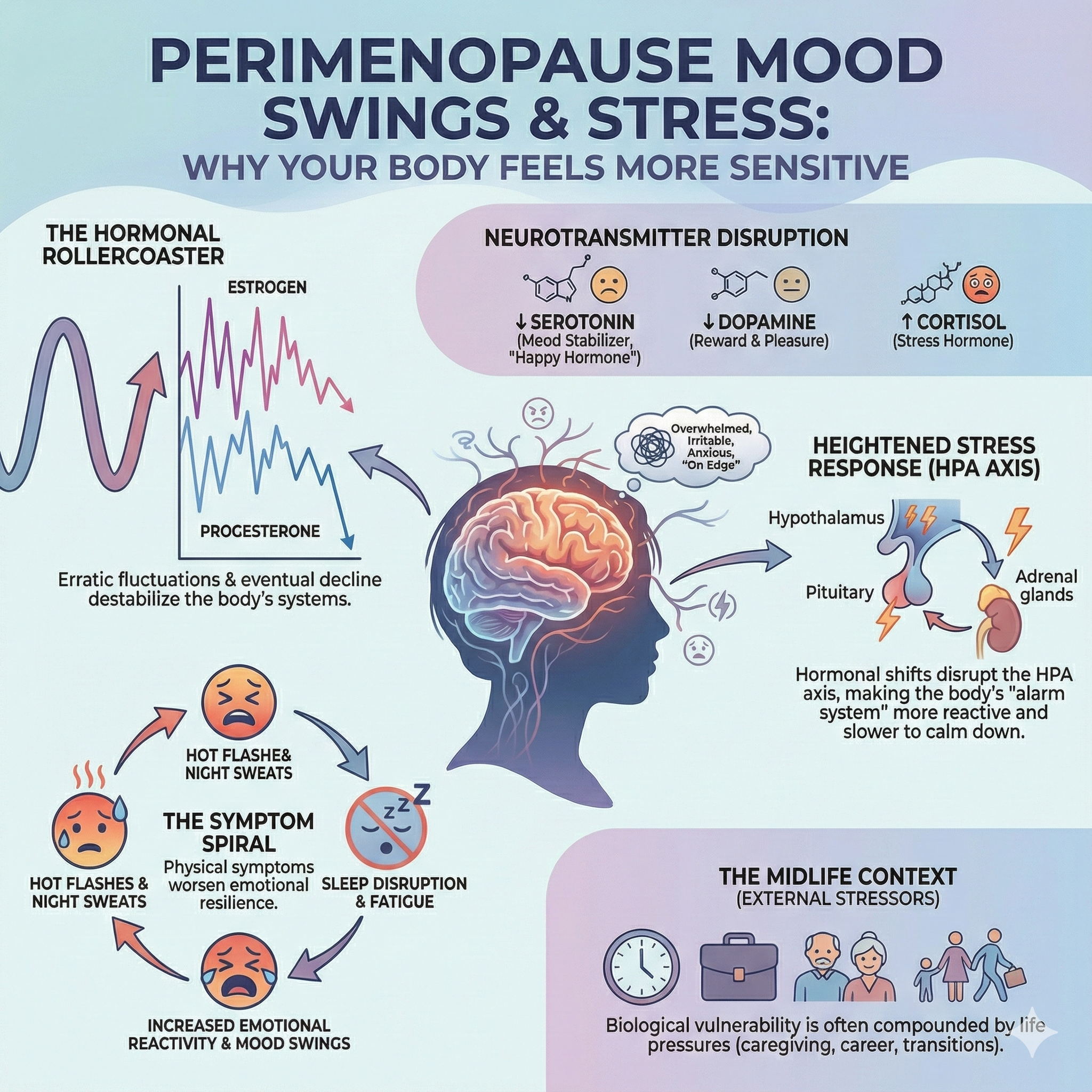
Hormones during perimenopause don't drop steadily, they swing. Those fluctuations can directly affect brain regions responsible for mood regulation. Researchers call this a "window of vulnerability," where hormonal instability can intensify emotional symptoms.
Here's what's happening:
- Hormone swings amplify stress reactions. Estradiol fluctuations during perimenopause appear to increase sensitivity to everyday stressors and negative emotional responses.
- Poor sleep compounds everything. When you're not sleeping deeply, your emotional reserves shrink and your body's recovery slows down.
- Your nervous system becomes hypervigilant. This shows up as muscle guarding, shallow breathing, digestive upset, or that exhausting "wired but tired" state.
This doesn't mean you're falling apart. It means your system is asking for different support.
Why everyday sensitivity increases
When clients describe feeling "more sensitive," they usually mean several things at once:
1) Tension accumulates quickly
Hormonal shifts combined with stress create more clenching and bracing. The usual culprits:
- Jaw and temples
- Neck and upper shoulders
- Chest and ribcage
- Lower back and hips
Your body is doing what it thinks is protective—even when there's no actual threat.
2) Emotions sit closer to the surface
You might react more strongly to tone of voice, conflict, bad news, or crowded environments. These responses are well-documented during perimenopause and often mirror intensified PMS symptoms.
3) Stress lingers longer than it should
A difficult morning can follow you into the night. You lie down hoping to relax, but your body won't cooperate. Your nervous system stays activated even when you're trying to rest.
4) The mind-body feedback loop tightens
Physical tension fuels emotional reactivity, and emotional reactivity fuels physical tension. This cycle is common, and it's one reason hands-on bodywork can be so effective. Not as a fix, but as relief.
How massage therapy supports you through this transition
Massage isn't about curing perimenopause. It's about giving your nervous system room to settle while you navigate this phase.
Research supports what many clients already know: manual therapy can reduce anxiety intensity, and massage has shown benefits for sleep disturbances and mood symptoms in menopausal and postmenopausal women. Results vary, but for many people, massage becomes a reliable anchor during an unpredictable time.
What sessions look like at Aurelia RMT
- Unhurried pacing that allows your body to genuinely relax
- Adjustable pressure based on how sensitive you're feeling that day
- Targeted work on common stress-holding areas—jaw, neck, shoulders, ribs, hips
- Space for breath without being told how to breathe
- A calm, low-demand environment where you don't need to explain yourself
Some days you'll want firmer work. Some days you'll need gentleness. Perimenopause asks for adaptability, and that's what you'll get.
When to seek additional support
Massage can be a meaningful part of your care, but it shouldn't carry the whole load if you're truly struggling.
Talk to your primary care provider if you notice:
- Low mood that persists for two weeks or more
- Anxiety that feels unmanageable
- Panic attacks
- Depression that's new or worsening
- Any thoughts of self-harm—please reach out for urgent support
You deserve care that matches what you're going through. You don't have to tough it out alone.
Ready to book?
If your body has been feeling more reactive lately, I'd be glad to help. At Aurelia RMT in Toronto, we'll meet your system where it is—no pressure, no performance required. Just thoughtful, grounding massage therapy.
Whenever you're ready, book a session and we'll start from wherever you are.
Key Takeaways
- ✓Perimenopause can cause mood swings, anxiety, and increased sensitivity due to hormonal fluctuations affecting mood regulation and stress response.
- ✓Physical symptoms during perimenopause include muscle tension, headaches, and disrupted sleep, which can exacerbate emotional reactivity.
- ✓Massage therapy can provide relief by helping the nervous system relax, reducing anxiety, and improving sleep and mood symptoms.
- ✓It's important to seek additional support from healthcare providers if experiencing persistent low mood, unmanageable anxiety, or thoughts of self-harm.
Frequently Asked Questions
What are common symptoms of perimenopause?
Common symptoms of perimenopause include mood swings, anxiety, shorter temper, emotional sensitivity, poor sleep, and increased muscle tension.
How does perimenopause affect stress response?
Perimenopause affects stress response by causing hormone fluctuations that amplify stress reactions and increase sensitivity to everyday stressors.
Can massage therapy help with perimenopause symptoms?
Yes, massage therapy can support perimenopause by reducing anxiety intensity, improving sleep disturbances, and providing relief from mood symptoms.
What should I do if I experience severe emotional symptoms during perimenopause?
If you experience severe emotional symptoms, such as persistent low mood, unmanageable anxiety, or thoughts of self-harm, you should talk to your primary care provider for additional support.
How does perimenopause impact sleep?
Perimenopause can lead to restless, broken, or unsatisfying sleep, which compounds emotional and physical symptoms.
References & Citations
- [1] Effectiveness of Therapeutic Massage for Generalized Anxiety Disorder: A Randomized Controlled Trial- A peer-reviewed randomized controlled trial published in Depression and Anxiety examining the effects of therapeutic massage on generalized anxiety disorder, showing that massage and other relaxation-based interventions can meaningfully reduce anxiety symptoms through generalized nervous system relaxation rather than condition-specific treatment.
- [2] Effect of massage in postmenopausal women with insomnia – A pilot study- A peer-reviewed pilot study published in Clinics (São Paulo) examining the effects of therapeutic massage in postmenopausal women with insomnia, showing improvements in sleep quality, anxiety, and depressive symptoms, with both subjective reports and objective sleep measures supporting massage as a beneficial supportive therapy during menopause.
- [3] A systematic review of manual therapy modalities and anxiety- A 2024 peer-reviewed systematic review published in the Journal of Osteopathic Medicine that evaluates multiple manual therapy modalities—including massage—for anxiety, concluding that manual therapies are associated with statistically significant reductions in anxiety intensity across a broad range of populations.
- [4] Mood Changes During Perimenopause Are Real. Here’s What to Know.- An evidence-informed patient education article from the American College of Obstetricians and Gynecologists (ACOG) explaining how hormonal fluctuations during perimenopause can affect mood, stress tolerance, sleep, anxiety, and depression, and outlining medically recognized causes, symptoms, and support options during the menopause transition.
- [5] Estradiol Fluctuation, Sensitivity to Stress, and Depressive Symptoms in the Menopause Transition: A Pilot Study- A peer-reviewed pilot study published in Frontiers in Psychology examining how estradiol fluctuations during the perimenopause transition are linked to increased sensitivity to stress and depressive symptoms, providing biological evidence for why mood reactivity and stress vulnerability increase during perimenopause.
- [6] Perimenopause- An evidence-based patient education page from The Menopause Society explaining what perimenopause is, how hormonal fluctuations affect menstrual cycles, mood, stress sensitivity, sleep, and mental health, and why symptoms such as depression, anxiety, brain fog, and emotional reactivity commonly increase during the menopause transition.
- [7] Mental Health- An evidence-based patient education page from The Menopause Society focused on mental health during the menopause transition, explaining how hormonal fluctuations—particularly during perimenopause—affect mood, anxiety, depression, cognition (brain fog), and stress sensitivity, and outlining common symptoms, risk factors, and supportive strategies.
- [8] Perimenopause and First-Onset Mood Disorders: A Closer Look- A peer-reviewed clinical review published in Focus: The Journal of Lifelong Learning in Psychiatry that examines how perimenopause is a documented window of vulnerability for first-onset mood disorders, detailing the roles of hormonal fluctuations (especially estrogen variability), stress, sleep disruption, and psychosocial factors in the development of depression and anxiety during the menopause transition.